

Which is the Best Pool for my Garden?
So you’re thinking about getting a pool for your backyard that will provide your family with years of fun, laughter, and enjoyment. Undoubtedly, owning a swimming pool will have a wonderful and lasting impact on your life. To make the most of this experience, it’s important to understand your options and which type of pool best suits your needs.
Although we at Leisure Pools are one of the world’s largest manufacturers of prefabricated fibreglass pools, we’ve decided to give you the honest and unbiased answers you need to answer this very important question. Let’s get started…
Option #1: Above-ground pools – advantages and disadvantages
Advantages of Above-Ground Pools
There is one definite advantage to an above-ground pool – the cost. Without a doubt, an above-ground pool will cost less than any type of in-ground pool (provided you don’t build a large deck around it; in that case, you could just as easily have bought an in-ground pool).
Disadvantages of Above-Ground Pools
For most people, the biggest drawback of above-ground pools is their aesthetics. Some simply don’t find them very attractive. Even with a deck built entirely around it, an above-ground pool generally won’t enhance the look of your house and garden. In fact, it will likely deter people from buying one or be seen as a necessary evil.
Another disadvantage of an above-ground pool is its limited depth and design options. Generally, most above-ground pools come in one of three shapes: circular, oval, or rectangular.
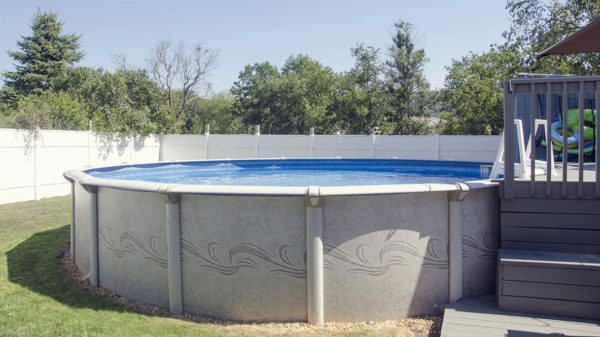
Above-ground pools simply aren’t built to last. Their metal walls can easily oxidize and rust, and most structures typically fail within 8 to 15 years. As a result, an above-ground pool is generally not considered an improvement when appraising a home and can be a deterrent when trying to sell.
Option #2: Vinyl Liner Inground Swimming Pools: Pros and Cons
Advantages of Vinyl Liner Pools
If you’re looking for an inground pool and have a very limited budget, vinyl liner may be the best option for you. Its material costs are low, and as a result, a vinyl liner pool typically costs $5,000 to $10,000 less upfront than its concrete or fibreglass counterparts.
With a vinyl liner pool, you have very few limitations when it comes to shape and size. With today’s technology, you can make your pool as deep, curved, straight, or large as you like.
Disadvantages of Vinyl Liner Pools
The biggest disadvantage of a vinyl liner in an in-ground pool is the liner itself. The material is a polymer, and it will degrade over time and need to be replaced. Additionally, the liner can easily tear or detach from the sides, causing it to slowly fall into the water.
On average (and regardless of what any “warranties” state), you can expect your in-ground vinyl liner to last between 7 and 12 years, with the average cost of replacement (labour, liner, and water) ranging from $3,000 to $7,000, depending on the size and shape of the pool.
Another disadvantage of a liner pool is its aesthetic appearance. Generally, a standard liner pool installation looks much “cheaper” and “temporary” than a fibreglass or concrete pool. As a result, in-ground pools with vinyl liners generally don’t add the same value to your home as a fibreglass or concrete pool of the same size.
In many countries, vinyl liner pools are no longer sold, and fibreglass and concrete pools are the preferred choice.
Option #3: Concrete (Gunite) Swimming Pools: Pros and Cons
Advantages of Concrete (Gunite) Pools
The main advantage of a concrete pool is its customisability, allowing it to be designed and adapted to any size, shape, or depth. Visually, this adaptability makes a concrete pool very attractive.
Concrete pools add value to a property and are a valuable asset if the owner plans to sell.
Disadvantages of Concrete (Gunite) Pools
By far the biggest disadvantage of a concrete pool is the high maintenance required to keep it looking beautiful, clear, and clean. A concrete pool not only requires more chemicals and brushes during the season but also undergoes an expensive resurfacing on average every 8-15 years.
Another disadvantage of a concrete pool is its rough surface. This roughness not only leads to acid erosion and slight algae growth but can also be very hard on children’s feet, causing them to bleed after just a few hours in the pool.
Concrete pools are also traditionally a lengthy construction process. This can be frustrating for homeowners, as they have a permanent construction zone in their yard for an average of three months.
Concrete pools are not ideal for salt chlorination. Although salt chlorinators can be installed in concrete pools, a concrete pool requires more maintenance and will need to be replaced sooner than one with traditional water disinfection. Given the many amazing benefits of salt chlorination, this is a disadvantage for concrete pools.
Option #4 Fibreglass Swimming Pools: Pros and Cons
Advantages of Fibreglass Pools
It is now generally accepted that fibreglass pools require the least maintenance of any swimming pool on the market today. With their smooth, non-porous surfaces, it is difficult for algae to grow on fibreglass, and when used with a salt chlorinator, the minimal maintenance is remarkable for many pool owners.
Fibreglass swimming pools can be installed in a very short time. The main reason is that the pool shell is manufactured off-site, meaning that once the hole for the pool is excavated, the finished pool structure can be lowered into it, and all that’s needed then is to complete the decking and landscaping around the pool. Fibreglass pools can be fully installed and ready to use in as little as 5 days.
Leisure Pools has made tremendous strides in fibreglass pool colour technology. Leisure Pools offers each of its pool designs in the Leisure Pools SMART color range. This new colour palette is available in 4 different colors, each with a spectacular glitter finish. The surface is smooth, preventing irritation to the skin of children and adults.
Leisure Pools has further advanced its manufacturing technology with the release of the Leisure Pools Composite Armour™ pool. This swimming pool has improved flexural and tensile strength, allowing Leisure Pools to offer a lifetime structural warranty and a lifetime osmosis warranty (see warranty terms and conditions). A lifetime warranty means no less than 35 years. These warranties far surpass those offered for above-ground, vinyl liner, and concrete pools.
Because a fibreglass pool is built from a mould, the advantage is that the design is exactly how the pool will look. We hear so many customers complain about concrete pools after they’re built because the design is moulded on-site, and in so many cases, the design the customer envisioned isn’t what the concrete pool builder ultimately delivers. With fibreglass pools, you know the exact design and size, allowing you to plan your backyard landscaping accordingly.
One of the great advantages of a fibreglass pool is the variety of designs available. Leisure Pools offers a wide range of designs to suit a variety of residential architectures. Our designs are based on extensive market research to identify the different features and benefits customers expect from a pool.
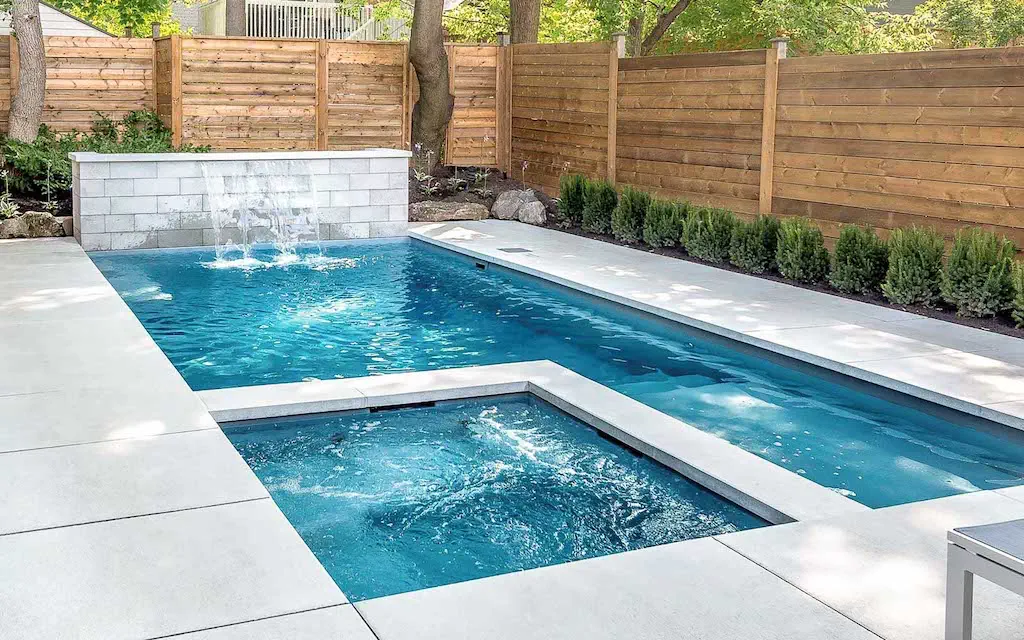
The Limitless™ – Fibreglass Pool with Built-in Spa
Disadvantages of Fibreglass Pools
The main disadvantage of a fibreglass pool is that it must be transported to your property by road, which limits the pool’s dimensions. Our largest fibreglass pool is 12 metres long and 4.8 metres wide. If you want a pool larger than this, a concrete pool is the best option. However, in reality, 95% of pools are less than 12 metres long.
The second disadvantage of fibreglass pools arises if you’re looking for a design not available in our standard range. Fibreglass pools are constructed using a mould, which is expensive to manufacture. Therefore, we are limited in the number of mould designs we offer. Leisure Pools conducts extensive market research to ensure we can offer a range of designs that meet 95% of customer needs. However, if you want a more unusual design, you may need to consider a concrete pool.
Conclusion: What is the best type of swimming pool?
We firmly believe that a Leisure Pools fibreglass composite swimming pool is the best pool structure available for 95% of customer needs. We encourage those on a budget to consider fibreglass over above-ground and vinyl pools. Even if you have to wait a year to recoup the difference in the long run, both in terms of maintenance and the added value to your home, it will be the best decision for you in the long term.


